Bruno Munari
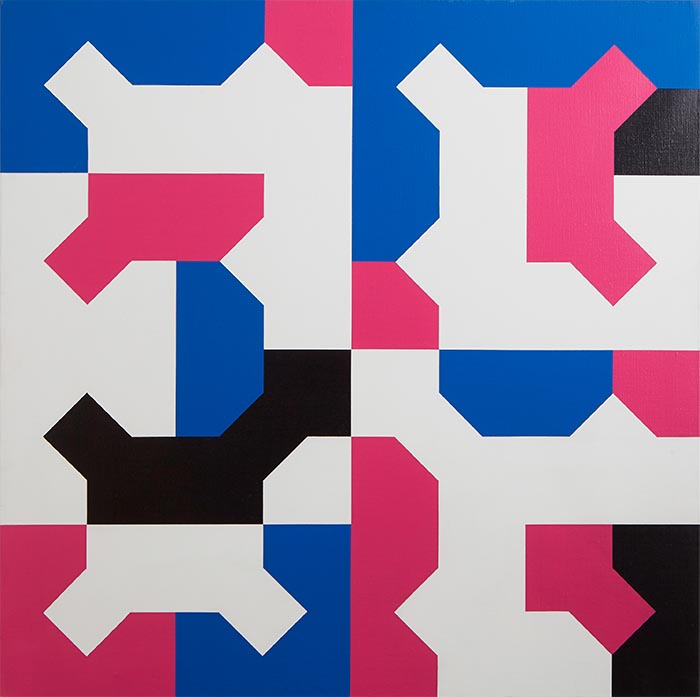
Bruno Munari
Peano curve P16-1
1974
80 x 80 cm
Acrylic on canvas
A multifaceted author, particularly interested in investigating the educational and communicative faculties of art, Munari distinguished himself for a multidisciplinary approach that involved painting, sculpture, design, teaching. Close to the beginnings of the second futurism, he presented, in the early thirties, his first Useless Machines, mobile objects in which abstract pictorial research meets three dimensions. After World War II he was one of the founders of MAC, a grouping that aims to verify the potential of a rigorously anti-mimetic painting, an expression of pure chromatic and compositional relationships. The attention to the movement, real or virtual, of the artistic object, later leads him to anticipate the research of kinetic and visual operators with some works. Guiding his work is the belief that the aesthetic value of the work is determined by the degree of accuracy and logical coherence of its formal structure. In the mid-seventies, Munari gave artistic form to the theorem of the mathematician Giuseppe Peano, who discovered a curved line without tangents capable of progressively filling the entire area of a square. Munari wrote in this regard, with his traditional understatement: «My proposal (…) lies in placing certain colors in the areas delimited by the line. Faced with this proposal, the observer is forced to imagine what the color of the square surface could be when the curve, shrinking and multiplying, has filled almost all of it. It is not necessary to think about it constantly, just once in a while. "
Other Artists
Carlo Nangeroni
Elementi Dinamici B
1972
150 x 150 cm
Acrylic on canvas
Christo
Kassel
1969
72 x 56 cm
Pencil, polythene, spag
Lucia Di Luciano
1965
80 x 80 cm